‘Destiny’ and the Making of Public Art History in Zambia
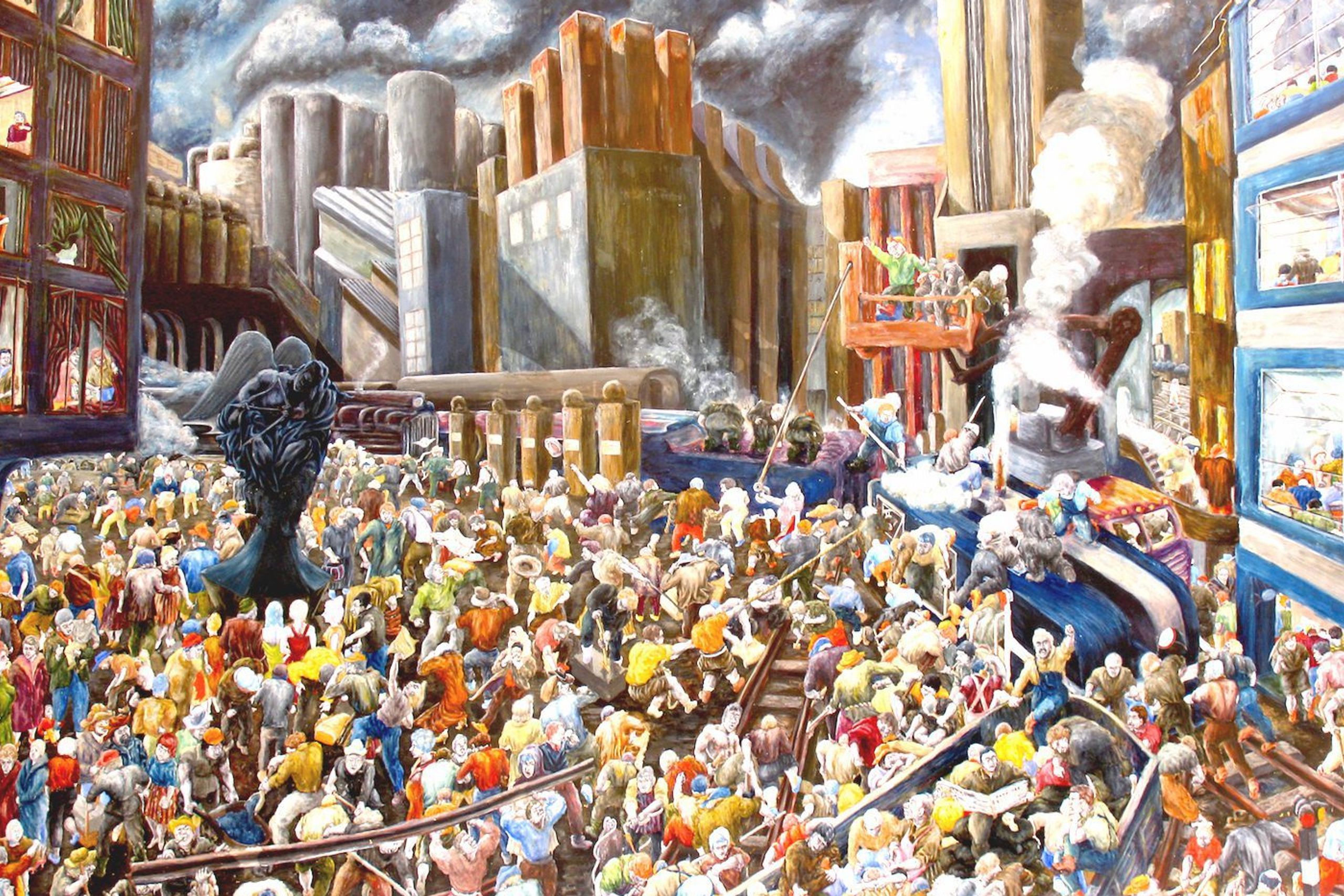
Henry Tayali, Destiny. Courtesy Lechwe Trust Art Gallery.
At the Lechwe Trust Art Gallery in Lusaka, Henry Tayali's Destiny (1962–65) came out of its crate for the first time in years. Writer Banji Chona visited Henry Tayali: Destiny, on show from February to April 2026, looking closely at the painting and at what it means for it to return to sustained public encounter.
I first encountered Henry Tayali’s Destiny (1962–65) at the Lechwe Trust Art Gallery in Lusaka in early February 2026. The painting lay on the floor of the gallery office, resting on its sturdy wooden crate. The timber was worn smooth in places through years of carrying and holding the treasure inside. I could sense the painting’s depth and density through the obscured surface of bubble wrap: wherever the textured plastic allowed, an accumulation of details seemed to insist on being found. Eventually I peeled back the protective layer and unveiled the thousands of small decisions held within the painting.
Seeing Destiny for the first time complicated the question that I assumed the exhibition would be asking. The painting was not being rediscovered. It had already returned to Zambia in 1991, when Lechwe Trust acquired it after it had traveled through Europe, with its final showing there at the Africa Centre in London in 1989. Cynthia Zukas, who co-founded Lechwe Trust in 1986 with Bente Lorenz and Henry Tayali, has spoken of how deeply the painting moved her when she saw it in London, and how determined she was to bring it home. After two years of negotiations with the family of Humphrey Gibbs, who had bought the painting when he was governor general of the colony of Southern Rhodesia (now Zimbabawe), Destiny became part of the Lechwe Trust collection. Now, more than thirty years later in 2026, the focus was different: Destiny was not coming back to Zambia but was instead returning to sustained public encounter.
Almost ten years ago, Dr. Andrew Mulenga wrote about Tayali’s work being “outside the spotlight” in Contemporary And (C&). Mulenga traced Tayali’s travels in Zambia, Zimbabwe, Uganda, and Germany, as well as his involvement in international art circles. He also highlighted Tayali’s efforts to advance art education, including his push to start a fine art school at the University of Zambia (UNZA) and to encourage systematic engagement with and study of African cultural materials. The department never materialized. Reading Mulenga’s 2017 essay alongside the 2026 exhibition raises a bigger question: what are the conditions that enable art histories to persist, including real accessibility for the public?
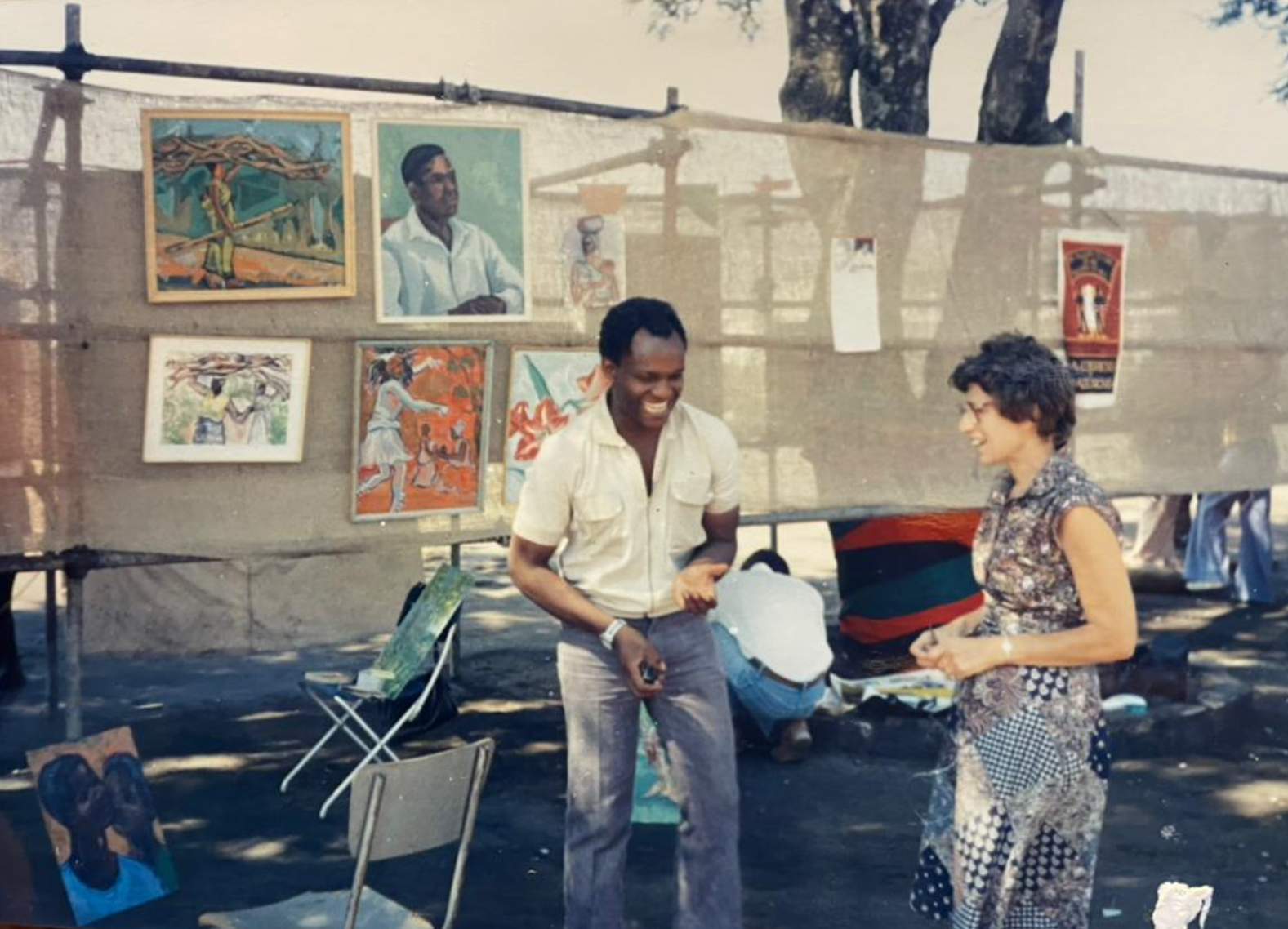
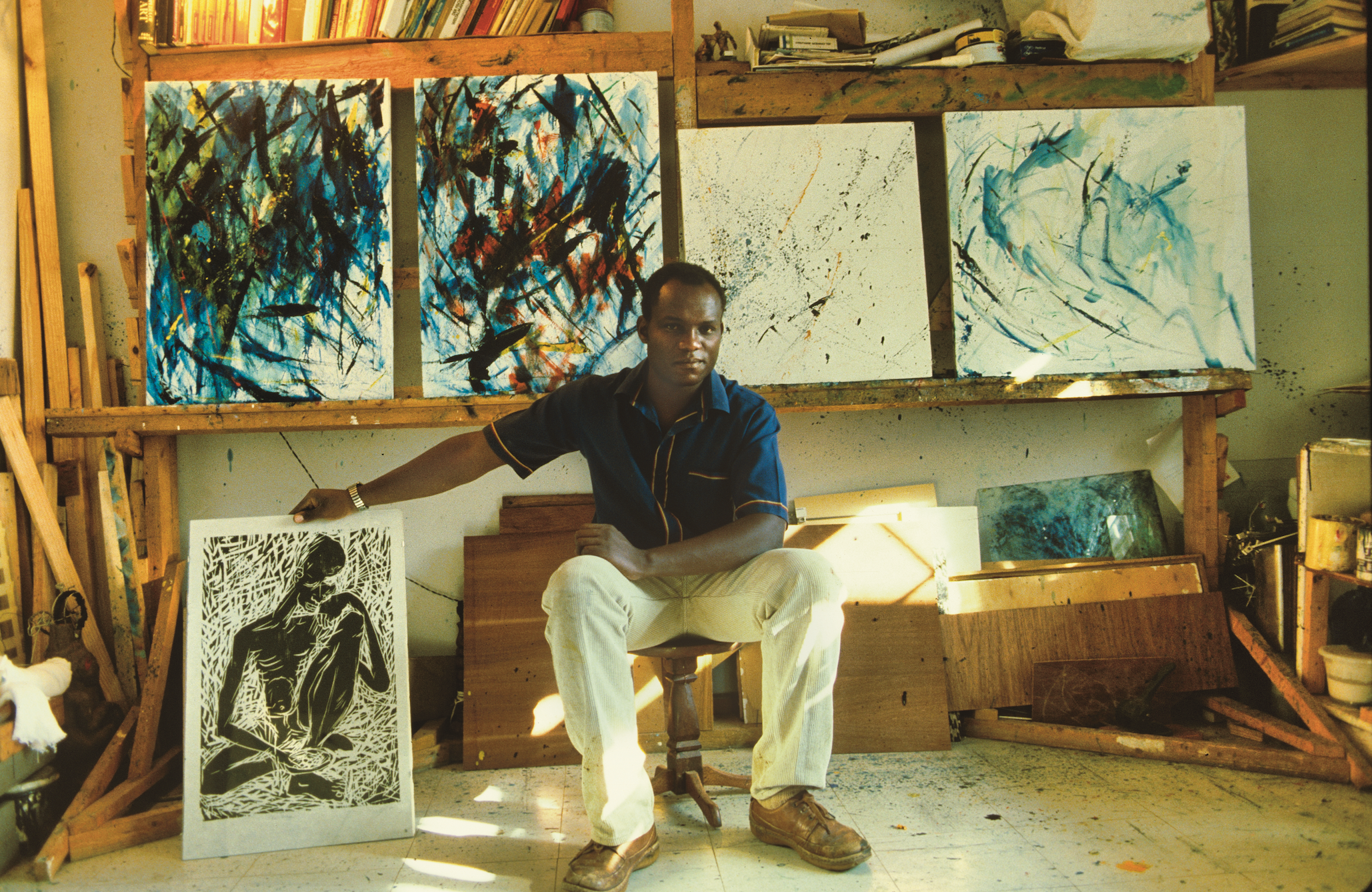
Tayali understood his practice as bound to the social world around him. Quotes from the artist in ZED magazine in 1975 and a 1982 Barclays Bank exhibition catalogue, later republished in the Mpapa Gallery catalogue Henry Tayali (1943–1987), articulate his concern for “the grinding needs and problems of the common man” at a time when people must “face the world with “serious intent and a grim will to survive.”
Looking closely at Destiny, those phrases could describe something present in the painting — which nevertheless resists straightforward interpretation. The industrial landscape of its foreground is populated by workers, elites, children, readers, smokers, and figures whose social positions are not always clear. One person reads a newspaper titled “100 Dead Men.” Some people’s hair is unexpectedly blue. Cigarettes produce almost lifelike plumes of smoke, while the children have adult faces. Those figures whose faces receive the most meticulous attention almost always have tired eyes. On the top floor of a building where affluent-looking people gather sits a painting within the painting. Tayali asks us to see the crowd, but gives us reasons to keep looking at the individuals.
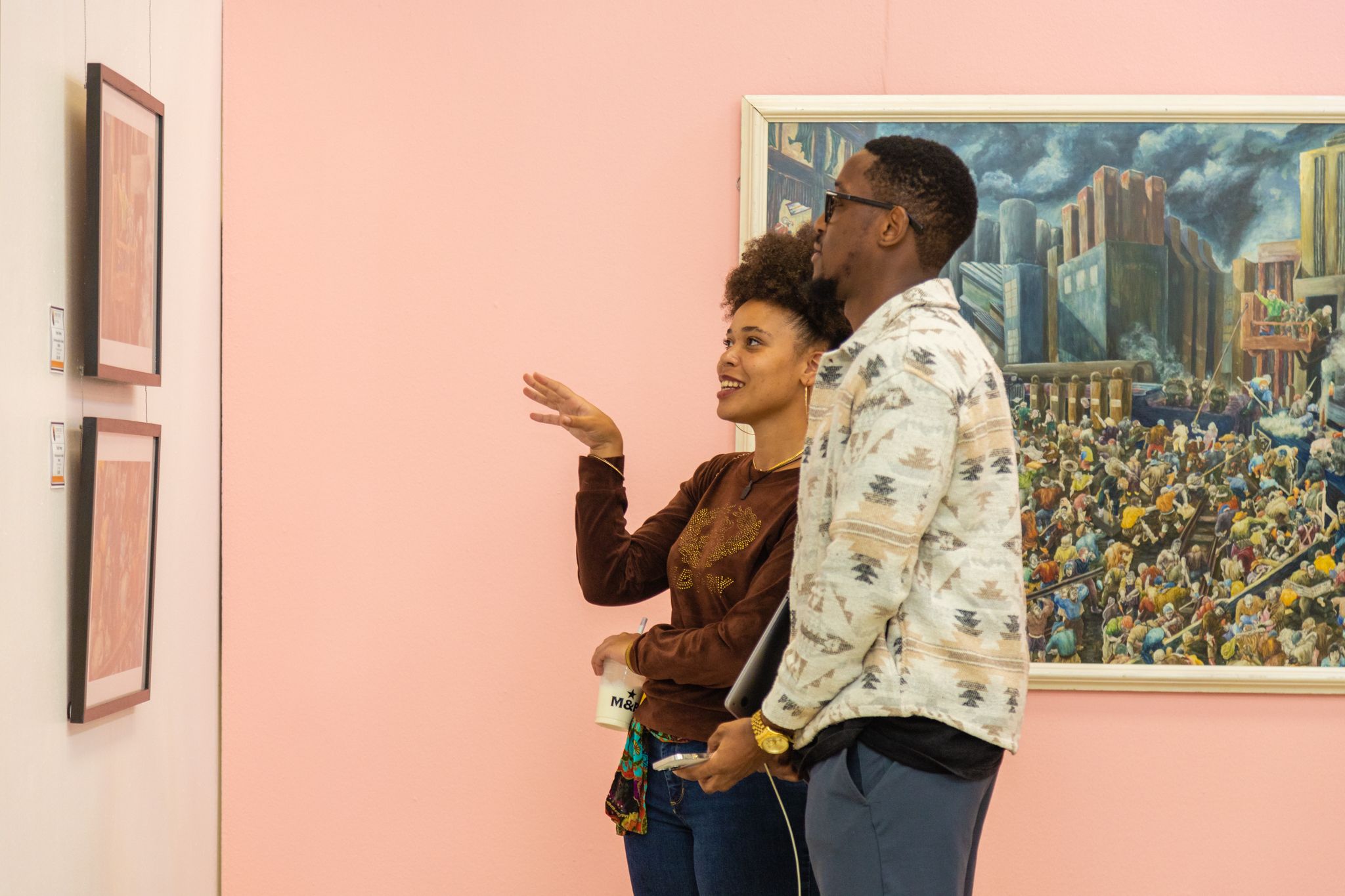
Henry Tayali, Destiny, 1965–69. Installation view, Destiny, Lechwe Trust Art Gallery, Lusaka, 2026. Photo: Mutumbi Lungu. Courtesy Lechwe Trust Art Gallery.
Many visitors experienced this when the painting was unveiled in February 2026 at the Lechwe Trust. Local artists, previously familiar with Destiny only through digital reproductions, encountered the 58×89cm oil-on-canvas work in person for the first time, appreciating its scale and complexity, revisiting specific details. The canonical image diminished as the physical object asserted its presence through its surface and its accumulation of artistic decisions. It became a site of encounter, where artists and viewers brought contemporary perspectives to a work shaped by distinct historical contexts.
The most moving encounters extended beyond the art itself. Tayali’s wife, Rosemary, and his daughter, Katwishi, offered memories of him as a husband and father. Rosemary remembered staying up late with him while he worked, including one night when she slept on the floor of the old German Embassy as he painted his 1977 mural African Market. Katwishi, who lost her father when she was young, recalled fragments, but remembered his dedication to his practice — an ethic she tries to embody in her own work.
That form of inheritance extended into the gallery, which was presenting multiple works by Tayali. One of the most striking was Untitled 5/25, a woodcut depicting a folded figure, its head resting on its hands and knees. Behind it, carved lines seemed to rise like memories to the surface. Different in scale and medium, the work felt connected to and animated by the same pressure as Destiny.
While Mulenga asked in 2017 what it meant for Tayali and other Zambian artists to have labored “outside the spotlight,” almost a decade later this exhibition suggested that the answer cannot be visibility alone. The more difficult work is creating the conditions in which visibility becomes continuity: where artworks are collected and encountered, artists remembered and studied, and institutions continually reactivate histories.
If Destiny could reside in a Zambian collection for over three decades while only intermittently appearing in public life, the central question is not simply whether Zambia possesses significant works, but what enables these works to remain present in public consciousness. Criticism, research, accessible archives, conservation, art education, and regular opportunities to engage with collections shape how art history is produced.
Although single exhibition cannot offer a solution on its own, it can demonstrate what becomes possible when a local institution does more than hold a work. Activating a collection is real art-historical work: researching its history, making it visible, bringing together related pieces, and creating a space where memories can accumulate. These processes transform it from a repository of completed histories into a site where histories can continue being questioned, taught, and made.
Art history is not secured by masterpieces alone; it is sustained through ongoing acts of care. The task then is not simply to bring additional works into public view, but to build the conditions that allow them to remain visible.
Destiny returned to Zambia in 1991. In 2026, it returned to public life.
About the author
Banji Chona
Banji Chona is a Zambezian artist, curator and researcher whose work examines cultural memory, material histories and contemporary artistic infrastructures. Through interdisciplinary research and artistic practice, she engages questions of heritage, ecology and public memory in Zambezia and beyond. Her writing and curatorial work contribute to ongoing conversations about art histories and cultural futures in Southern Africa.
Review
Portia Zvavahera’s House of Praise
The Heart of the Matter: Carrie Mae Weems at FOMU Antwerp
The Re:assemblages Symposium: How Might We Gather Differently?
Review
Werewere Liking: Of Spirit, Sound, and the Shape of Transmission
Paris Noir: Pan-African Surrealism, Abstraction and Figuration